











AI offers huge opportunities for governments, educational institutions and other organisations that process large amounts of information. Think of intelligent search functions, digital assistants and applications that help staff make faster, better-founded decisions.
The technology is often not the biggest obstacle. These days we can build a working AI prototype surprisingly quickly. The real challenge starts when that prototype has to grow into a secure, scalable and responsibly set-up production application.
Because where is the data processed? Who has access? Are prompts and answers stored? Can processing take place within Europe? And how do you prevent sensitive information from becoming accessible through an unsecured API key?
Those are questions you should not leave until just before launch.
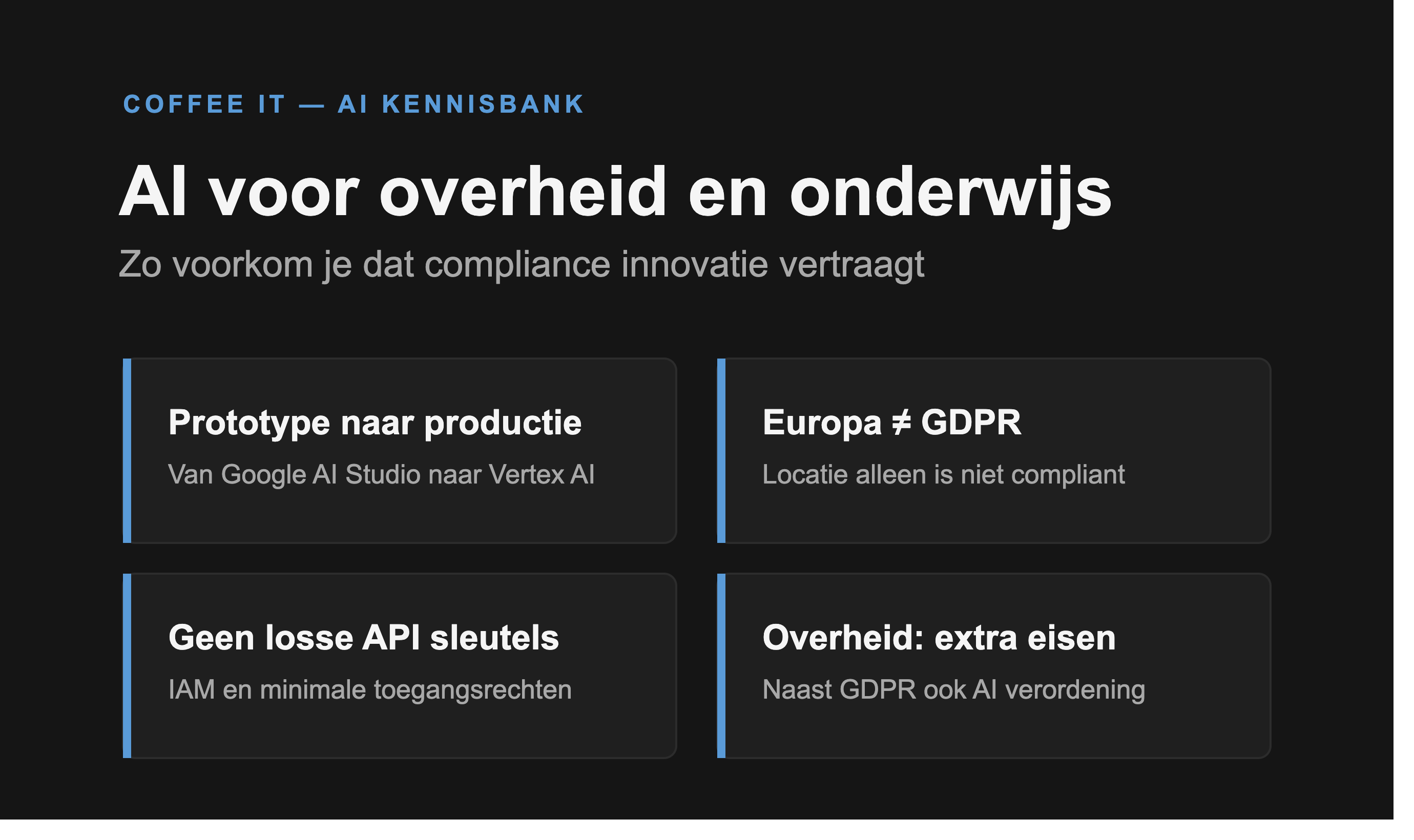
From experiment to production environment
While developing an AI application for a client in education, we at Coffee IT ran into exactly these questions.
In the first phase we used Google AI Studio. That is an accessible environment where developers can quickly experiment with AI models and prompts. Ideal for exploring and validating a concept, but not automatically the right choice for every business production environment.
Because the application is used in education, we had to take stricter requirements into account around privacy, data processing, access management and governance. So together with the client we moved to Vertex AI, which is also part of Google Cloud.
That move gave us much more control over the technical and organisational set-up of the AI application.
Where AI processing happens matters
For applications that process personal data, confidential documents or organisational data, it is important to know where data is stored and where the actual AI processing takes place.
Vertex AI lets you explicitly configure the region in which AI processing takes place. This means processing can be set up within European regions, provided the chosen model and configuration support it.
An important nuance applies here. Not every model and not every feature is available in every European region. And using a European cloud project does not automatically mean all AI requests are processed within Europe.
The chosen region, the model, the endpoint used and the configuration all have to line up.
That is why, for each application, Coffee IT checks things such as:
- Which data is sent to the AI model
- Whether that data contains personal data or confidential information
- Where the data is stored
- Where the AI processing takes place
- Whether the chosen model is available in the desired region
- Which logging and retention periods are active
So ticking a box for Europe is not enough. The entire data flow has to be right.
European processing is not the same as GDPR compliance
Processing data within Europe is important, but it does not automatically make an application fully GDPR compliant.
The GDPR covers, among other things, the purpose of processing, the amount of data collected, retention periods, security, transparency, data subject rights and agreements with processors.
For a responsible AI application you therefore need to look at more than where the servers are. The following questions matter too:
- Is there a valid legal basis for the processing?
- Is it clear which data is sent to the model?
- Can personal data be removed or anonymised beforehand?
- Is there a data processing agreement with the supplier?
- Which sub-processors are involved?
- How long are prompts, answers and log files kept?
- Is data used to train or improve models?
- Can data subjects exercise their privacy rights?
Technology can make a lot possible, but the organisation remains responsible for how personal data is processed.
No loose API keys in a production application
Another important difference between an experiment and a production application is how access to the AI platform is arranged.
Prototypes regularly use a static API key. That is simple, but it carries risks. A key can accidentally end up in source code, log files or configuration files. It is also harder to control exactly which application or employee may perform which actions.
Vertex AI supports Google Cloud Identity and Access Management. This lets organisations work with service accounts, roles and fine-grained access rights.
For example, you can set a particular application to call only one specific model, while administrators have broader rights. Access can then follow the principle of least privilege (each user or system gets only the rights it needs).
When an application communicates from another cloud environment, authentication can also be set up through federated identities. That way no long-lived keys need to be exchanged between environments.
That makes the environment more secure and easier to manage.
Logging, monitoring and cost control
An AI application should not only be secure. You also want to understand what is happening.
How often is the model called? Which errors occur? How long does an answer take? Which user or application made a request? And what does usage cost per department, client or feature?
A business environment such as Vertex AI offers options for:
- Central logging and monitoring
- Managing roles and access rights
- Insight into usage and costs
- Scalability as usage grows
- Separation between development, test and production environments
- Control over models, configurations and releases
This may sound technical, but it directly affects the reliability of the application. Without good monitoring, an unexpected rise in usage can lead to high costs or reduced availability, for example.
Governments often face additional requirements
For government organisations, additional standards, policy frameworks and procurement requirements often apply on top of the GDPR.
Think of requirements around information security, archiving, transparency, supplier management, digital sovereignty and the explainability of automated processes. European AI regulation may also apply, depending on the purpose and risk profile of the application.
That is why Coffee IT does not start by selecting an AI model.
We start with the context:
- Who is the application for?
- Which decisions does AI support?
- Which data is processed?
- Can the AI affect rights, access or services?
- Must an employee always check the result?
- Which requirements apply to the organisation and its suppliers?
Only then do we decide which technical set-up and which model fit.
Regulation does not have to slow innovation
Regulation does not have to hold innovation back. Above all, it makes organisations take more deliberate decisions.
An AI prototype can still be built and tested quickly. It is just important to decide upfront which parts are temporary and which requirements apply before the application is actually used by staff, residents, pupils or customers.
At Coffee IT we are enthusiastic about what AI makes possible. Especially for governments, educational institutions and civil society organisations, AI can lead to more accessible services, less administrative work and faster access to knowledge.
But enthusiasm has to go hand in hand with responsibility.
A good AI application is therefore more than a smart model. It is a combination of a strong user experience, secure software, suitable infrastructure, clear governance and careful handling of data.
From working prototype to reliable application
The move from Google AI Studio to Vertex AI in this client project shows how an AI project can develop in practice.
You start by validating an idea. Then you look at what it takes to put the concept into practice securely and manageably. Sometimes that means making different choices for the production environment than during the first experiment.
That is not a limit on innovation. That is mature software development.
Coffee IT helps organisations design and develop AI applications that are not only impressive in a demo, but can also be used securely, at scale and responsibly in the real world.
Are you a government body, educational institution or other organisation with plans for an AI application? Then bring privacy, security and data location into the project from the very first design decisions. That way you avoid having to rebuild a successful prototype from scratch later on.
This article is intended as a practical explanation and does not constitute legal advice.